
War, inflation and rising government debt are putting fresh pressure on global bond markets. Here’s why higher borrowing costs could matter for households, businesses and the wider economy.
Why the Cost of Borrowing Is Rising — And Why It Matters for the Global Economy
Financial markets are facing a new source of pressure as geopolitical conflict, expensive energy, persistent inflation and enormous government borrowing collide.
While stock markets often receive the most attention, developments in the bond market can have much broader consequences. Rising government bond yields can eventually affect everything from mortgage rates and business loans to government finances and investment decisions.
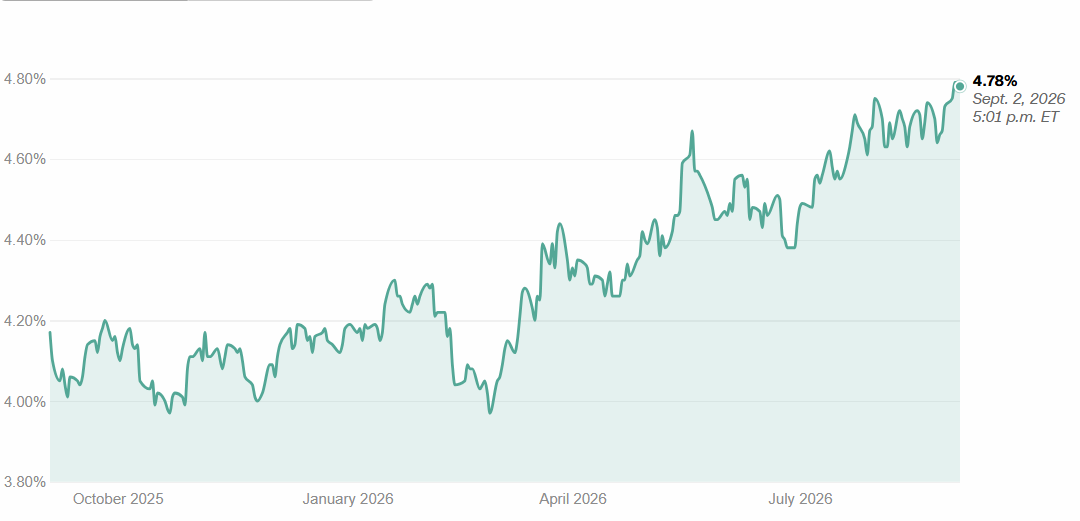
Recent reporting from CNN Business highlights growing stress in the U.S. Treasury market as the conflict with Iran continues and investors reassess inflation, energy prices and government borrowing. The benchmark 10-year U.S. Treasury yield recently climbed to its highest level in nearly three years.
So why is this happening, and why should people outside Wall Street care?
War Is Adding New Pressure
Military conflicts are expensive in more ways than one.
The ongoing conflict involving the United States and Iran has increased defense spending while also disrupting an important part of the world’s energy supply system.
According to CNN’s analysis, the conflict has continued for more than six months, forcing investors to reconsider expectations for energy prices, inflation and bonds.
Energy is particularly important because higher fuel costs can spread throughout an economy.
Businesses need fuel to transport products. Airlines depend on jet fuel. Manufacturers and farmers face transportation and energy expenses. When those costs rise, companies may eventually pass at least part of the increase on to consumers.
That can make inflation more difficult to control.
Higher Energy Prices Can Keep Inflation Elevated
Energy disruption has already created noticeable pressure.
CNN reports that diesel prices had risen 51% since the war began, while the previous month became the most expensive August for U.S. gasoline prices on record, according to AAA.
The concern for investors is what happens if elevated energy prices persist.
When inflation remains stubbornly high, central banks have less room to reduce interest rates. They may even have to consider tighter monetary policy.
That expectation can push bond yields higher.
Why Bond Yields Matter to Everyday People
The bond market can sound distant from everyday life, but its effects are surprisingly direct.
When government bond yields rise, borrowing throughout the economy can become more expensive.
Businesses considering a new factory or expansion may face higher financing costs. Small businesses may pay more for loans. Consumers can encounter higher mortgage and other borrowing rates.
This is why a major increase in bond yields can eventually slow economic activity.
Companies may delay investments, households may reconsider large purchases, and governments have to devote more money to servicing existing debt.
This Isn’t Just an American Story
Pressure in bond markets has spread beyond the United States.
CNN reports that Germany’s 10-year government yield recently reached a level not seen since 2011. Britain’s 30-year yield reached its highest level since 1998, while Japan’s benchmark 10-year government bond yield crossed 3% for the first time since 1996.
That makes the current situation significant for the global economy rather than just U.S. financial markets.
Governments around the world are dealing with combinations of inflation, defense expenditures, existing debt and new borrowing requirements.
Government Debt Is Becoming More Expensive
The United States has another major challenge: the sheer size of its debt.
U.S. national debt recently reached $40 trillion, according to the reporting cited by CNN.
Higher interest rates make that debt increasingly expensive to finance.
CNN cites Treasury figures showing that the U.S. had spent approximately $931 billion on net interest during the fiscal year at the time of publication. That was already above the roughly $804 billion spent on national defense.
This creates a difficult cycle.
If a government needs to borrow more while interest rates are high, a larger portion of future spending can be consumed simply by interest payments.
Defense Spending Adds Another Layer
Wars themselves require additional government spending that may not have been included in earlier budgets.
CNN reports that the Iran conflict is costing the United States billions of dollars in additional defense spending, requiring further borrowing. The report also notes increased defense spending in Europe, Japan and South Korea amid broader security concerns.
That means governments may be competing for investors’ money at a time when borrowing is already expensive.
There’s Another Huge Borrower: Artificial Intelligence
Governments aren’t alone.
The enormous investment required to build AI infrastructure is creating another source of demand for capital.
Technology companies are spending heavily on data centers and other infrastructure needed for the AI boom, with significant portions of that investment being financed through bond markets.
More demand for financing can create additional competition in capital markets.
Governments need money.
Technology companies need money.
Defense spending requires money.
And investors are demanding increasingly attractive returns to provide it.
What Could Happen Next?
Much depends on inflation, energy prices, the direction of the conflict and central-bank policy.
If energy prices stabilize and inflationary pressure eases, bond markets could eventually calm.
But if conflict intensifies, energy prices remain elevated and governments continue borrowing heavily, financing costs could remain under pressure.
That would matter far beyond financial markets.
Higher borrowing costs can influence housing, business investment, government budgets and ultimately economic growth.
For now, the bond market is sending an important message: the price of money itself is becoming more expensive.
And when borrowing becomes significantly more expensive across multiple major economies at the same time, the consequences can eventually reach almost everyone.
Article Source & Reference
This article was independently written and summarizes economic issues discussed in reporting and analysis by Matt Egan for CNN Business, titled “The war is raising the price of money. That’s a problem for the global economy,” published September 2, 2026. The original CNN report also draws on government data, market information and comments from financial-market analysts.
